Sleep article
Sleep Is Part of the Workout
## A Guide for High School Wrestlers
*By Jon Gums*
Ask a room full of wrestlers what wins matches and you’ll hear conditioning, technique, mat time and toughness. Sleep probably won’t make the list.
It should.
When you’re balancing school, practice, lifting and a tournament schedule, sleep is easy to squeeze out. But it’s part of how you recover from all that work—and show up ready to do it again.
## How Much Do You Need?
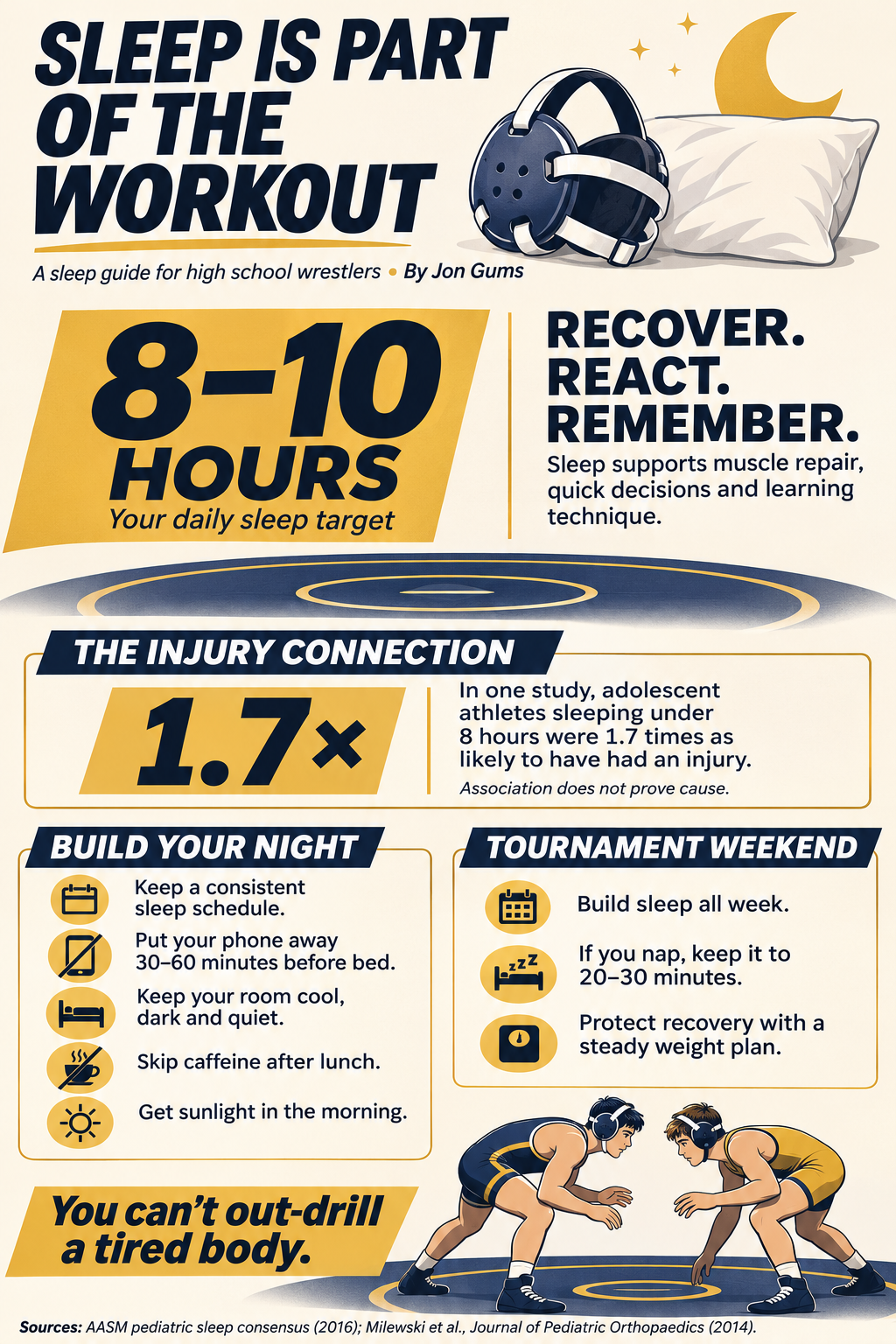
The American Academy of Sleep Medicine recommends 8 to 10 hours of sleep per 24 hours for teenagers ages 13 to 18. For a high school wrestler, that’s a target worth planning around.
Getting there isn’t always easy. During the teen years, the body’s internal clock tends to shift later. You may not feel sleepy at 9:30, even when you know the alarm is set for 5:45.
But an early lift doesn’t make your need for sleep disappear. If you’re regularly getting six or seven hours, look at your whole schedule with your parents and coach. Your recovery needs a place in it.
## What Happens After You Fall Asleep?
Practice gives your body work to recover from. Sleep gives it time to do that work.
Deep sleep helps support the processes involved in growth and muscle repair. Sleep also helps your brain hold on to what you learned. That setup you drilled all afternoon? Getting some rest is part of learning it.
There’s an injury connection, too. A 2014 study found that adolescent athletes who averaged fewer than eight hours of sleep were 1.7 times as likely to have had an injury as those who averaged at least eight. That doesn’t prove short sleep caused the injuries, and the study wasn’t specific to wrestlers. Still, it’s a finding worth paying attention to in a demanding sport.
Rest also supports attention, reaction time and decision-making. When you’re tired, reading a shot or reacting in a scramble can get harder. More conditioning isn’t always the answer.
## Sleep and Making Weight
If you’ve ever felt hungry all day after a short night, you know how much harder food choices can feel when you’re exhausted.
Too little sleep can affect the signals that help regulate hunger and fullness. It can make an already demanding weight plan harder to manage.
And staying up late to sweat off weight means giving up recovery right before you need to compete. Work with your coach, parents and a qualified health professional on a sensible plan that supports growth, fueling and recovery. Sleep belongs in that plan.
## Get Ready Before Friday Night
An early bus and a long Saturday are part of wrestling season. That makes the nights leading up to a tournament matter.
One early bedtime on Friday won’t erase a week of short nights. Give yourself a chance to sleep well throughout the week, and try to keep weekend wake-up times within about an hour of your usual schedule.
If there’s time to rest between matches, find a quiet spot. A short nap of 20 to 30 minutes may help, but leave yourself time to wake up before warming up. Headphones and a hoodie can make the bus ride a little easier, too.
## A Routine You Can Actually Use
You don’t need a perfect bedtime routine. Start with a few habits you can repeat:
– Go to bed and get up at roughly the same time each day.
– Put your phone away 30 to 60 minutes before bed. Outside the bedroom is even better.
– Keep your room cool, dark and quiet.
– Skip caffeine and energy drinks after lunch.
– If you’re hungry, have a small snack that fits your nutrition plan.
– Get outside for some morning light.
Pick one or two and build from there.
## Put Sleep on the Training Plan
You make time for drilling, lifting and conditioning because they help you wrestle better. Give sleep the same respect.
You can’t out-drill a tired body. Aim for 8 to 10 hours, build a routine you can keep, and give yourself a chance to benefit from the work you’re putting in.
*Sources: American Academy of Sleep Medicine, pediatric sleep consensus statement (2016); Milewski et al., “Chronic Lack of Sleep Is Associated With Increased Sports Injuries in Adolescent Athletes,” Journal of Pediatric Orthopaedics (2014).*
Dakota_Grappler_2026-27_Coach_Questionnaire (3)